Wreck Diving: Complete Wreck Diver Guide, Training & Best Sites
What is wreck diving and how do you become a wreck diver? Learn exterior vs penetration rules, PADI/SSI courses, essential wreck gear, and where to start.
Wreck Diving: What It Is, Training, and Where to Start
Wreck diving is scuba diving on ships, aircraft, or other structures that now sit on the seabed. Some went down by accident. Others were cleaned and scuttled as artificial reefs. Either way, you are diving a three-dimensional object with history, metal, and marine life attached to it — not a coral wall.
This guide explains what wreck diving actually involves at recreational level, how it differs from penetration and technical wreck work, the hazards that catch people out, and the training path from Open Water through a wreck specialty. If you already know you want the card, jump to our wreck diving certification guide.
What Wreck Diving Actually Means
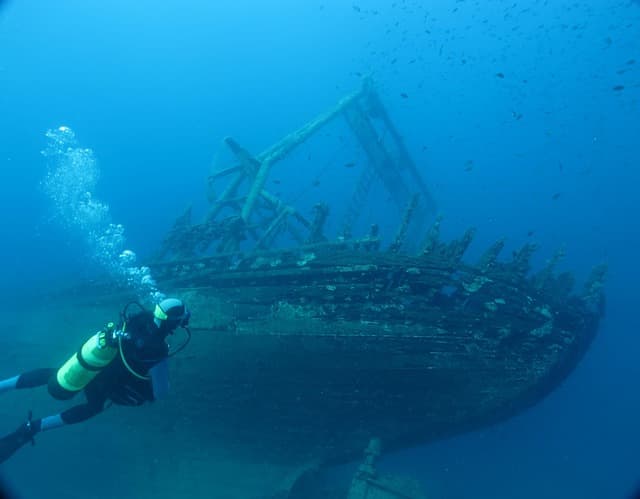 Image by Martin Str
A wreck dive can be as simple as swimming around a purpose-sunk freighter in 15 metres of clear water. It can also mean a cold, dark, silty hull at 40 metres that you have no business entering. The word “wreck” covers both, which is why people talk past each other.
Accidental wrecks sank because of war, weather, collision, or grounding. Cargo, fittings, and personal effects may still be on board. Many are war graves. They were not prepared for divers: hatches can be jammed, compartments can silt out, and fishing net often wraps the superstructure.
Scuttled wrecks were usually stripped of fuel, oils, and loose hazards, then sunk on purpose as dive sites or artificial reefs. Jordan’s Cedar Pride in Aqaba is a well-known example: cleaned, positioned, and left to grow coral. They are often more predictable than accidental wrecks, but they are still overhead environments once you go inside.
Aircraft wrecks sit in the same category. A Corsica B-17 or a Red Sea fighter is smaller than a cargo ship, but the same rules apply: sharp metal, entanglement, and no free ascent if you go into the fuselage.
Wreck diving is not automatically “advanced.” Plenty of Open Water divers enjoy exterior tours of shallow wrecks. The difficulty comes from depth, current, overhead, and whether you plan to go inside.
Recreational, Penetration, and Technical Wreck Diving
Keep these three layers separate. Mixing them up is how people get hurt.
Recreational wreck diving (exterior). You stay outside the hull or in wide, obviously open swim-throughs that still have a direct, unobstructed path to the surface. Depth stays within your certification: 18 metres for Open Water, 30 metres for Advanced Open Water, and 40 metres with a Deep specialty. This is how most holiday wreck dives are run.
Limited penetration. You enter the wreck, but you stay in the natural light zone and within a short linear distance of open water. PADI’s recreational wreck specialty treats this as a trained skill with a reel, lights, and hard limits — typically remaining in the light zone and no more than about 40 metres of combined depth and horizontal travel from the surface. If the wreck sits at 30 metres, that leaves very little room to go in. At 40 metres you should not enter at all. This is not “a quick look in the engine room because the guide went first.”
Technical wreck diving. Deeper than 40 metres, beyond the light zone, through restrictions, or with decompression obligation. That is a different sport: redundant gas, guidelines, and training that is much closer to cave work than to a Red Sea day boat. Do not treat a famous name on a magazine list as permission to go there on air with a single tank.
If a briefing says “we swim through the holds,” ask whether that is a wide, lit opening with a clear exit, or a true overhead. If you do not hold a wreck specialty, stay outside.
Hazards You Need to Take Seriously
Wrecks concentrate risk that reef dives spread out.
Silt. Decades of sediment sit on decks, in companionways, and in engine rooms. One poor fin kick can drop visibility to zero. You cannot see the exit, your buddy, or your gauges. Frog kick, hover, and keep fins off the bottom. If you silt it out, stop, hold the line, and wait rather than thrashing.
Entanglement. Fishing net, monofilament, and loose cable love wrecks. A cutting tool you can reach with either hand is not optional kit for wreck diving. Practice using it before you need it.
Overhead. Once a ceiling of metal is over you, you cannot make a free ascent. A regulator problem that is annoying in open water becomes an emergency. That is why penetration is trained, lined, and limited.
Sharp metal and collapse. Wrecks decay. Plates fold, wood rots, and what was a solid bulkhead ten years ago may not be now. Gloves help against cuts. They do not help if you pull on a beam that then shifts. Do not use the wreck as a handrail.
Depth and gas. Many photogenic wrecks sit at 25–35 metres. Air goes fast, no-stop time is short, and narcosis can creep in. Know your depth limits before you book a “must-do” wreck whose sand is at 32 metres.
War graves and legal status. Military wrecks and many merchant losses with loss of life are graves. Dive them as you would a cemetery: no souvenirs, no interior “exploration” for trophies, no moving bones or personal effects. Local law often bans artefact removal even on non-military wrecks. Take photographs. Leave the wreck as you found it.
None of this means wreck diving is reckless. It means the site is less forgiving than a house reef if you improvise.
Do You Need a Wreck Diving Specialty?
You do not need a wreck specialty to dive around a wreck within your depth limit, with a guide, staying outside. Plenty of Open Water divers do exactly that on shallow scuttled ships and on the upper decks of deeper wrecks.
You do need wreck training — and you should refuse the dive — if the plan includes going inside: engine rooms, cargo holds that are not wide-open, cabins, or any space where you lose a straight shot to the surface. A guide who “always takes people in” is not a substitute for your own training. Instructors still operate within agency limits; random day-boat staff do not get a free pass.
The PADI Advanced Open Water wreck adventure dive is an introduction. It is usually an exterior dive with mapping and hazard awareness. It is not a penetration qualification. Completing it does not mean you are certified to lay line into a dark hold.
If wrecks are a regular part of how you want to dive, take the specialty. The course exists because silt, line, and overhead are skills, not vibes. Study the wreck knowledge review before you travel if you like to arrive prepared.
Extra Gear for Wreck Dives
Standard scuba gear gets you to the site. A few extras matter specifically on wrecks.
Lights. A primary light plus a backup. Even on a sunny Red Sea wreck, interiors and the shaded side of the hull are dim. Lights also help you see true colour on rust and coral. If you cannot see natural light toward the exit, you are past recreational penetration limits.
Reel and line. For trained limited penetration, a wreck reel is how you find the way out if visibility collapses. You learn to lay it, follow it, and handle a trapped line without yanking. Do not improvise with a cheap spool you have never used.
Cutting tool. A line cutter or shears mounted where you can reach it, not buried in a pocket under a camera. Net is common on popular wrecks.
Redundancy. Many wreck divers carry an alternate air source that is not just a dangling octopus — a pony bottle for deeper wrecks, or at least a well-secured backup second stage. Recreational specialties discuss this; technical wreck courses require it.
Gloves and exposure. Metal is sharp. Cold wrecks (Scapa, Baltic) need a drysuit, which is its own skill. Do not add overhead and a first drysuit dive on the same morning.
Buoyancy and trim matter more than any gadget. If you cannot hover without using your hands, you will silt a wreck and bang the wreck. Peak Performance Buoyancy is a better “first extra course” than wreck penetration if your trim is still messy.
The Certification Path from Open Water to Wreck Diver
A sensible path looks like this.
1. Open Water Diver. You can dive to 18 metres. That already includes the tops of some wrecks: HMS Maori in Malta, parts of the Cedar Pride, shallow sections of Abu Nuhas. Stay outside. Get comfortable with buoyancy in the sea, not only in a pool.
2. Advanced Open Water, including the wreck adventure dive if it is offered. AOW takes you to 30 metres, which is the depth of a large share of the world’s famous wrecks. The wreck adventure dive is a supervised exterior introduction. Take Deep as well if you know you want 30-metre sand, because many wrecks sit right on that limit.
3. Wreck Diver specialty (PADI) or the SSI equivalent path. PADI Wreck Diver is typically four dives, age 15, with Adventure Diver or AOW (or a qualifying equivalent). You cover hazards, mapping, equipment, and limited light-zone penetration with a line. SSI splits the idea: Wreck Diving is non-penetration around wrecks; Advanced Wreck Diving is the limited-penetration piece. Details, costs, and how the two agencies differ are in the certification article linked above.
4. Deep specialty if the wrecks you want sit near 40 metres. Recreational maximum on air is 40 metres. That is not a target; it is a ceiling. Nitrogen, gas supply, and no-stop time all get tight.
5. Technical training only if you actually need it. HMHS Britannic, the deep Scapa battleships, and full dark-zone penetration are not “the next specialty after wreck.” They are trimix, deco, and overhead programs.
You can dive a lot of excellent wrecks without ever going inside. That is a valid way to enjoy wreck diving for years.
Where to Start Wreck Diving
Start on a wreck that matches your depth and your training, in water you can see, with an operator who will not push you through a hatch.
Warm, clear, relatively shallow wrecks are kinder first sites than cold, tidal, silty ones. The Red Sea is a common starting point for that reason. The SS Thistlegorm is the wreck many divers fly for — cargo holds of wartime vehicles at around 30 metres, Advanced territory, and a war grave. North of Hurghada, the Abu Nuhas wrecks (Giannis D, Carnatic, Chrisoula K, Kimon M) give you four ships on one reef, with some sections Open Water divers can see from outside.
If you want a European circuit, use our best wreck diving in Europe ranking and our Malta wreck diving guide as a map, not a bucket list to rush. Malta’s HMS Maori is a genuine Open Water wreck. Um El Faroud and P29 ask for AOW for the full hull. Scapa Flow is a cold-water, drysuit, Advanced project. HMHS Britannic is technical only, and the MS Estonia wreck is legally off-limits as a protected grave site.
Further afield, wreck diving in Alexandria is deeper Mediterranean steel, mostly 30–45 metres, and seasonal. Baltic wrecks off Estonia are a different lesson again: preservation, cold, and modest visibility.
For a worldwide snapshot of the names that keep appearing in dive media — Thistlegorm, Zenobia, Truk, Coron, Coolidge, and the rest — see best wreck diving in the world. Use it to choose a destination, then read the site-specific depth before you book. Warm-water wrecks we cover in full include Coron and Cozumel’s C-53. Andrea Doria is technical only.
What “Best Wreck Diving” Lists Actually Mean
“Best wreck diving” lists are popularity contests. They measure how often a wreck is photographed, written about, and sold on liveaboards — not a scientific quality score, and not a ranking of how safe they are for you.
A wreck can be “the best in the world” and still be a poor choice for an Open Water diver, a drysuit beginner, or someone who has never used a reel. Thistlegorm is extraordinary and also deep, busy, and current-prone. Zenobia is huge and also goes to 42 metres. Britannic is historically unique and also 110 metres.
Treat lists as a shortlist of famous sites. Then filter by:
- Maximum depth versus your certification
- Whether the interesting parts are exterior or interior
- Water temperature and whether you need a drysuit
- Whether the wreck is a war grave with extra rules
- Boat time, cost, and season
The “best” wreck dive is the one you can do within your training, with gas and no-stop margin, and still remember clearly. That is often a 20-metre scuttled ship you swim around twice, not a magazine cover you exceed your limits to tick.
Final Thoughts
Wreck diving is one of the most satisfying ways to use a scuba qualification: history, structure, and fish in one site. It is also one of the easiest ways to step outside recreational rules if you follow a group into a dark compartment “just for a look.”
Stay outside until you have wreck training. Stay in the light zone even then. Leave artefacts where they are. Match the wreck to Open Water, Advanced, Deep, or technical — not to Instagram.
If you are choosing a first wreck trip, pick a clear-water destination, read the depth, and decide in advance that the hull is the dive, not the interior. When you are ready for the specialty, the certification guide and a wreck knowledge review will do more for you than another untrained swim-through.
Frequently Asked Questions
- Do I need a wreck specialty to dive a wreck?
- No, not if you stay outside the hull and within your depth limit (18 m Open Water, 30 m Advanced). You do need wreck training before any real penetration — engine rooms, dark holds, or anywhere you lose a straight path to the surface.
- What is wreck penetration?
- Penetration means entering the wreck so that metal is overhead and you cannot ascend directly. Recreational wreck courses limit this to the natural light zone and a short linear distance from the surface (often 40 m combined). Dark-zone and technical penetration is a separate qualification.
- Can Open Water divers do wreck dives?
- Yes, on shallow wrecks and on the upper parts of deeper ones. HMS Maori in Malta, parts of the Cedar Pride, and the tops of some Abu Nuhas wrecks are genuine Open Water dives if you remain outside. Famous deep wrecks such as Thistlegorm need Advanced Open Water.
- Is it legal to take souvenirs from a wreck?
- Usually no. Many wrecks are protected heritage sites or war graves. Removing artefacts is illegal in most jurisdictions and destroys the dive for everyone after you. Photograph and leave things where they are.
- What extra gear do I need for wreck diving?
- A primary light and a backup, a cutting tool you can reach, and — if you are trained for limited penetration — a wreck reel and line. Gloves help on sharp metal where local rules allow them. Buoyancy and trim matter more than extra gadgets.
- How deep can I go on a wreck?
- Your certification still applies: 18 m Open Water, 30 m Advanced Open Water, 40 m with a Deep specialty. A wreck sitting on sand at 32 m is an Advanced dive even if the mast is shallower. Recreational wreck training does not raise those depth limits.
Related articles
- Wreck Diving Course & Certification: PADI vs SSI Wreck Diver Guide
Comparing a PADI or SSI wreck diving course? Learn prerequisites, 4-dive vs 2-dive wreck diver certification paths, costs, gear, and light-zone penetration rules.
- Best Wreck Diving in Europe: Ranked Sites and Depths
Best wreck diving in Europe ranked by popularity: Zenobia, Scapa Flow, Um El Faroud, Baron Gautsch, and more — with depth, licence, and Mediterranean notes.
- Best Wreck Diving in the World: Famous Sites Guide
Best wreck diving in the world: Thistlegorm, Zenobia, Truk, Coron, Spiegel Grove, Liberty, Coolidge, and Um El Faroud — with depths and certification notes.
- Diving the SS Thistlegorm: The Red Sea's Most Famous Wreck
Descend into history. Discover why the SS Thistlegorm is considered the best wreck dive in the world, with its cargo of WWII motorcycles and trucks.
- From Open Water to Nitrox and Wreck: How to Prepare for PADI Specialty Exams
PADI specialty courses like Advanced Open Water, Enriched Air (Nitrox), Wreck Diver, and Peak Performance Buoyancy all have exams. Learn what each covers and how to prepare with free practice quizzes.