Best Wreck Diving in the World: Famous Sites Guide
Best wreck diving in the world: Thistlegorm, Zenobia, Truk, Coron, Spiegel Grove, Liberty, Coolidge, and Um El Faroud — with depths and certification notes.
Best Wreck Diving in the World: Famous Sites Guide
Ask ten wreck divers for the best wreck diving in the world and you will hear the same handful of names: Thistlegorm, Zenobia, Truk, Coron, Coolidge, Liberty, Spiegel Grove. Those wrecks dominate magazines and liveaboard brochures. They are famous for good reasons. They are not all suitable for the same diver.
This is a roundup of roughly ten wrecks that define “best wreck diving” in popular dive media, with depth and certification notes so you can tell a holiday dive from a technical expedition. It is not a quality score. For how wreck diving works as a skill, see the wreck diving hub. For a Europe-only ranking, use best wreck diving in Europe.
How This List Was Chosen
These sites appear again and again in dive publications, operator itineraries, and diver conversations. Inclusion means fame and a distinctive dive — cargo still in the holds, a complete ocean liner, a whole lagoon of warships — not that we have dived a scored checklist.
Depths are typical published ranges. Local skippers, tide, and which part of the wreck you visit will shift the number on your computer. Certification notes use PADI recreational limits: Open Water 18 metres, Advanced Open Water 30 metres, Deep specialty 40 metres. Going inside still requires wreck training, famous name or not.
We have dedicated guides for some of these wrecks. For others — Truk, Florida, Coolidge, Liberty — we do not. Those remain “also consider” destinations. Do not treat a short paragraph here as a dive briefing.
Nitrox is useful on almost all of these once you are certified, because no-stop time at 30 metres is short. It does not increase your maximum depth. A wreck specialty does not increase it either. Depth and overhead are separate limits.
SS Thistlegorm, Egypt
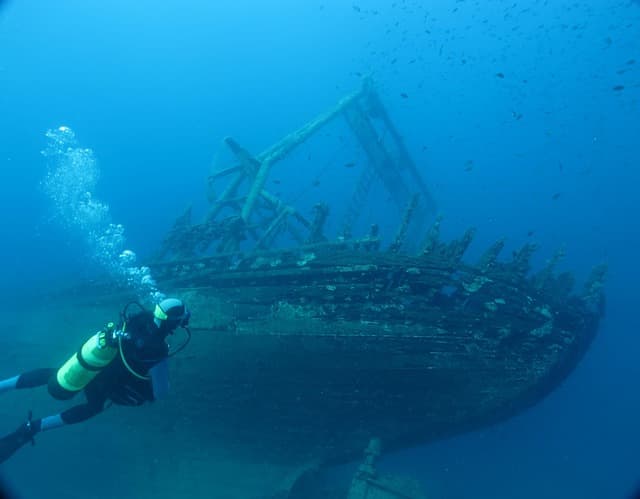 Image by Martin Str
The British merchant ship SS Thistlegorm was bombed at anchor in the Strait of Gubal in October 1941. She sits on sand at about 32 metres, with the shallowest useful parts of the superstructure around 15–18 metres. That puts a proper visit firmly in Advanced Open Water territory, often with current on the shotline.
What made her a celebrity is the cargo: BSA and Norton motorcycles, Bedford trucks, ammunition, and two locomotives blown off the deck. Holds can be wide and lit enough that some day boats treat them as swim-throughs. That is still overhead. Without a wreck specialty, stay in open, obviously lit spaces or remain outside. She is a war grave. Do not take souvenirs.
Most divers reach her on a very early day boat from Sharm El Sheikh or on a northern Red Sea liveaboard. Crowds and current are part of the dive. Read the full site guide: diving the SS Thistlegorm.
If you are already in the northern Red Sea and want more wrecks in a single day, Abu Nuhas sits in the same shipping lane: Giannis D, Carnatic, Chrisoula K, and Kimon M, generally shallower and more Open Water–friendly on the upper sections. Many divers do Thistlegorm as the “headline” and Abu Nuhas as the wreck density. They are complementary, not duplicates.
MS Zenobia, Cyprus
MS Zenobia rolled and sank off Larnaca in 1980 on her maiden cargo run. She is a 172-metre roll-on/roll-off ferry lying on her port side. The wreck runs from about 16 metres on the upper (starboard) rail to about 42 metres on the sand.
Open Water divers can, on a calm day with a sensible guide, visit the shallow rail and get a sense of the scale. A proper tour of trucks in the holds, the accommodation, and the deeper hull is Advanced, and the sand is Deep / 40-metre recreational if you go all the way down. Limited penetration of the light zone belongs to wreck-trained divers; the dark garage decks are not an AOW extra.
Zenobia is often called a European wreck in dive media even though Cyprus sits in the eastern Mediterranean. Conditions are typically warm and clear compared with Scapa or the Baltic. Shore support in Larnaca is easier than a four-hour steam to Thistlegorm. We cover her in Zenobia wreck diving in Cyprus.
If you can only do one “world famous” wreck in a wetsuit with short boat rides, Zenobia is the usual European answer. If you want wartime cargo in situ, Thistlegorm still wins that particular comparison.
Truk Lagoon and Coron
Truk Lagoon (Chuuk) is not one wreck. It is the Japanese fleet caught by Operation Hailstone in February 1944: tankers, cargo ships, a few warships, aircraft, and trucks in holds that still look staged. Names you will hear include Fujikawa Maru, Shinkoku Maru, and deeper technical wrecks that never appear on recreational day-boat lists.
Many of the classic dives sit in the 20–40 metre recreational band. Others go well past 40 metres and are trimix dives. Water is warm. Overhead in engine rooms is still overhead. Liveaboards are the usual way to reach the best sites; this is a dedicated trip, not a day boat from a beach resort. We do not have a Chuuk guide on this site. If wrecks of World War II in warm water are your goal, treat Truk as a research project: operator reputation, nitrox, wreck training, and an honest look at which wrecks match 30 versus 40 metres.
Coron (Palawan, Philippines) is another World War II Japanese supply fleet, bombed on 24 September 1944. Wrecks such as Okikawa Maru, Irako, Akitsushima, and several gunboats sit in a sheltered bay. Depths range from Open Water decks to Deep-only sand on Irako. It is often compared with Truk: warm water, war history, wreck-dense itineraries, and easier logistics for many travellers. Untrained penetration is commonly offered. Decline interiors unless you hold a wreck specialty. Full destination guide: Coron wreck diving.
Also consider Coron if you are building a wreck-travel list after Egypt or Malta. Both lagoons reward wreck-trained Advanced divers more than they reward a first Open Water holiday. For a single Caribbean wreck rather than a fleet, Cozumel wreck diving (the C-53 minesweeper) is the usual Mexican answer.
Florida Keys, USAT Liberty, and President Coolidge
Three more names round out the global “best wreck diving” conversation. We do not have full destination guides for them. Treat the notes as filters.
The Florida Keys, especially off Key Largo, are a purpose-sunk wreck playground: Spiegel Grove, Duane, Bibb, and others. Spiegel Grove is a 155-metre US Navy landing ship dock, scuttled in 2002. After a hurricane she now sits upright. The deck is often quoted around 18–20 metres, the sand near 40 metres. Open Water divers can see the top on a good day; Advanced divers can tour the exterior; Deep specialty owners can reach the sand. Open hatches still require wreck training. Currents and boat traffic are real. If you already dive in the US, this is the convenient “world class wreck” option.
USAT Liberty at Tulamben, Bali, is one of the most dived wrecks on Earth because you can walk in from the beach. The US Army transport was torpedoed in 1942, beached, then slipped into the water after volcanic activity in 1963. She lies on her side from about 5 metres to about 30 metres. Open Water divers can enjoy a great deal of the wreck. Advanced divers can work the deeper stern. Coral growth is thick. It is busy. Penetration of tight spaces is still a specialty skill. Liberty is the reminder that best wreck diving includes shore dives, not only liveaboards.
The President Coolidge in Vanuatu was a converted ocean liner that hit US mines in the Segond Channel, Espiritu Santo, in 1942. She is enormous. Recreational dives typically start around 21 metres at the bow and work into the mid-section. The famous “Lady” statue is often quoted near 40 metres. The stern drops toward 70 metres and is technical. Coolidge is a multi-day wreck with set guide routes. Many routes are true penetration. Hold wreck training (and Deep, for the Lady) rather than following a group into the medical stores. She is a war grave. If a liner-sized wreck with long bottom times is the goal, Coolidge belongs on the research list with a technical option if you want the stern.
Um El Faroud and Other European Standouts
Europe’s “best wreck diving” names overlap with the world list because magazines treat Zenobia as both. Malta’s Um El Faroud, a scuttled tanker at about 15–36 metres, is a staple Advanced wreck: upright, photogenic, and a short boat ride. Details live with our Europe ranking and the Um El Faroud guide.
Scapa Flow’s German High Seas Fleet, Malta’s HMS Maori and P29, Croatia’s Baron Gautsch, Corsica’s B-17, Hyères’ Donator, Gibraltar’s wrecks, and technical-only Britannic are the rest of that European conversation. Use the Europe hub for depths and licences rather than repeating the table here.
Abu Nuhas, already mentioned with Thistlegorm, is the Red Sea’s “four wrecks, one reef” answer for divers who want wreck density without flying to Micronesia. If your question is “where do I start famous wreck diving without a liveaboard to Chuuk,” Egypt plus Malta plus Cyprus is the practical circuit.
Depth and Certification at a Glance
| Wreck | Typical depth | Typical recreational licence |
|---|---|---|
| USAT Liberty (Bali) | 5–30 m | OW shallow / AOW deeper stern |
| Okikawa Maru (Coron) | deck 10–16 m | OW deck |
| C-53 Cozumel | 12–25 m | OW top / AOW tour |
| HMS Maori (Malta) | 14–18 m | OW |
| Abu Nuhas (upper sections) | 4–18 m | OW exterior |
| Spiegel Grove (deck) | ~18–20 m | OW top / AOW tour |
| Zenobia (rail) | ~16 m | OW with a conservative plan |
| Thistlegorm | 15–32 m | AOW |
| Um El Faroud | 15–36 m | AOW |
| Abu Nuhas (Kimon M / deeper bits) | to ~32 m | AOW |
| Zenobia (sand) / Spiegel Grove (sand) | to ~40–42 m | AOW + Deep |
| Coolidge (Lady / mid) | ~21–40 m | AOW + Deep; wreck training for interiors |
| Coolidge (stern) / Britannic / Andrea Doria / deep Truk | 70–120 m (Doria ~60–76 m) | Technical only |
Read the table as a filter. If you are Open Water, Liberty’s shallows, Maori, Abu Nuhas topsides, and a conservative Zenobia rail are the honest world-famous options. If you are Advanced, Thistlegorm, Faroud, Truk’s recreational circuit, and most of Zenobia open up. If you do not have Deep, do not plan your holiday around the sand at 40 metres. If you do not have wreck training, do not plan it around engine rooms. Andrea Doria is technical only — see Andrea Doria wreck diving.
Final Thoughts
The best wreck diving in the world is a short list of over-photographed ships and lagoons. Use it to pick a region: Red Sea cargo and reefs, Mediterranean ferries and tankers, Pacific war fleets, Florida artificial reefs, or a Bali shore wreck.
Then ignore the word “best” and read the depth. Open Water has a genuine wreck menu. Advanced Open Water unlocks Thistlegorm, much of Zenobia, Um El Faroud, and the classic Truk circuit. Deep specialty is the recreational ceiling at 40 metres. Technical training is mandatory for Britannic, Andrea Doria, Coolidge’s stern, and the deep end of Truk.
Stay out of interiors without a wreck specialty. Leave war graves intact. If you want a first famous wreck, Thistlegorm or Abu Nuhas plus a clear briefing will teach you more than a rushed tick of every name in this article.
Frequently Asked Questions
- What is the most famous wreck dive in the world?
- The SS Thistlegorm in the Red Sea is the name most recreational divers give. MS Zenobia, Truk Lagoon, the President Coolidge, and USAT Liberty are the other fixtures on magazine lists. Fame is not the same as being the right wreck for your certification.
- Can Open Water divers do world-famous wrecks?
- Some of them, in part. USAT Liberty’s shallows, HMS Maori, the upper sections of Abu Nuhas, Spiegel Grove’s deck, and a conservative pass of Zenobia’s rail can work at 18 m. Thistlegorm’s sand at 32 m needs Advanced Open Water.
- Do I need wreck training for Thistlegorm or Zenobia?
- You need Advanced Open Water (and often Deep for Zenobia’s sand) for a proper exterior tour. You need a wreck specialty before entering holds, garages, or engine rooms. A guide swimming in first is not a substitute for that training.
- Is Truk Lagoon recreational or technical?
- Both. Many classic Chuuk wrecks sit between 20 and 40 metres and are dived recreationally, usually from a liveaboard. Other wrecks in the lagoon are deeper than 40 metres and require technical trimix training. Book the actual wrecks, not the lagoon name.
- Where should I start if I want famous wreck diving?
- A northern Red Sea trip covering Thistlegorm and Abu Nuhas, or a Malta week with Um El Faroud and HMS Maori, is a practical first circuit. Truk, Coron, Coolidge, and Florida are worth considering once you know your depth and whether you will stay outside.
Related articles
- Wreck Diving: Complete Wreck Diver Guide, Training & Best Sites
What is wreck diving and how do you become a wreck diver? Learn exterior vs penetration rules, PADI/SSI courses, essential wreck gear, and where to start.
- Best Wreck Diving in Europe: Ranked Sites and Depths
Best wreck diving in Europe ranked by popularity: Zenobia, Scapa Flow, Um El Faroud, Baron Gautsch, and more — with depth, licence, and Mediterranean notes.
- Diving the SS Thistlegorm: The Red Sea's Most Famous Wreck
Descend into history. Discover why the SS Thistlegorm is considered the best wreck dive in the world, with its cargo of WWII motorcycles and trucks.
- MS Zenobia Wreck Diving in Cyprus: Depths and Guide
Dive the MS Zenobia off Larnaca: a 172 m ferry on her port side, trucks still chained, from 16 m to 42 m. Boat dive for Open Water to wreck-trained divers.
- Abu Nuhas Wrecks: Giannis D, Carnatic & Chrisoula K
Abu Nuhas wrecks north of Hurghada: Giannis D, Carnatic, Chrisoula K, and Kimon M — depths, Open Water vs AOW, and how day boats actually run the reef.
- Coron Wreck Diving: WWII Japanese Fleet in Palawan
Coron wreck diving covers the Japanese fleet sunk in September 1944: Okikawa Maru, Irako, Akitsushima, and more. Depths, licenses, and how to choose a wreck.
- Cozumel Wreck Diving: C-53 Felipe Xicoténcatl Guide
Cozumel wreck diving means the C-53 Felipe Xicoténcatl: a scuttled minesweeper at 12–25 m near Chankanaab. Depth, currents, license, and how to dive it.
- Andrea Doria Wreck Diving: Why It Is Technical Only
Andrea Doria wreck diving is not a holiday dive. The Italian liner lies off Nantucket at 60–76 m. History, depth, and why recreational divers cannot go.