Scapa Flow Wreck Diving: Orkney's German Fleet Guide
Dive Scapa Flow in Orkney: German battleships and cruisers scuttled in 1919, 12–47 m, cold water, June–September. Advanced Open Water is the realistic minimum.
Scapa Flow Wreck Diving: Orkney's German Fleet Guide
Scapa Flow is not a single wreck. It is a harbour full of German naval history, sitting in a natural basin in the Orkney Islands of Scotland. After the First World War the High Seas Fleet was interned here. On 21 June 1919 Admiral Ludwig von Reuter ordered the fleet scuttled rather than let it pass intact into Allied hands. Most of the big ships were later salvaged. What remains for divers is still extraordinary: battleships and cruisers in roughly 12–47 metres of cold, green water.
This is British wreck diving at its most serious. It is also one of the great chapters in any European wreck diving list. Come for the fleet. Stay for SMS Markgraf, the wreck that still feels like a battleship when the vis opens.
This guide covers the story of the scuttle, the depth profile of the remaining ships, how you get on them, the skills you need, what you will actually see, how to dive them as war graves, and the practical side of an Orkney week.
The Story of the Wrecks
In November 1918 the German High Seas Fleet steamed north under the armistice and dropped anchor in Scapa Flow. The crews were interned. The ships were not yet prizes. Through the winter and spring of 1919 the political argument about who would get which vessel dragged on.
On 21 June 1919, while many British escort ships were out of the Flow on exercise, von Reuter gave the signal. Sea cocks were opened. Boats were lowered. Seventy-four ships went down or were beached in the attempt. Nine sailors died in the confusion and in confrontations as the British tried to save what they could. It was the last act of the Imperial German Navy, carried out in a Scottish harbour.
Salvage in the 1920s and 1930s lifted most of the battleships and battlecruisers for scrap. What visiting divers come for now is the residue of that industry: three König-class battleships that were left, and a handful of light cruisers. The remaining diveable battleships and cruisers include SMS Markgraf, König, Kronprinz Wilhelm, Cöln, Dresden, Brummer, and Karlsruhe. Depths across that list run from the shallow teens to the high forties.
These are warships and they are graves. Some men died in the scuttling. Many more had already died in the war that put the fleet here. Orkney and Historic Environment Scotland treat the sites as historic wrecks. The correct attitude is the same as on any war grave: look, do not take, do not rearrange the ship for a photograph.
Markgraf is the ship this guide spotlights. She is a König-class dreadnought, interned with her sisters, scuttled with the fleet, and never raised. She lies inverted or heavily turned depending on which account and which part of the hull you are on; what matters in the water is scale. Guns, armour, and a hull that eats your no-stop time. If you only remember one name from a Scapa week, it will probably be hers.
Depth and Dive Profile
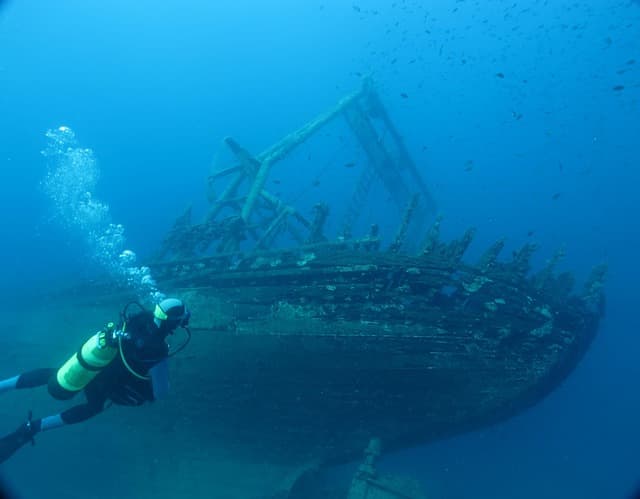 Image by Martin Str
The remaining battleships and cruisers sit in a band of about 12–47 metres. That spread is why “Scapa Flow” is not one qualification. A cruiser deck in the twenties is an Advanced dive. A battleship keel toward 45–47 metres is a Deep dive, and often a decompression dive if you linger.
A typical day-boat profile is two wrecks, or two dives on the same wreck, with a long surface interval. First dive often goes to a cruiser: Cöln, Dresden, Brummer, or Karlsruhe, where you can learn the vis, the cold, and the shot-line discipline. Second dive, or a later day, is a battleship: Markgraf, König, or Kronprinz Wilhelm.
Water temperature is 8–14°C in the season. There is no tropical thermocline surprise; it is simply cold from the splash. Visibility is often 8–15 metres. That is enough to read a turret or a cruiser stern. It is not Red Sea vis. You navigate by the wreck, not by seeing the entire ship from the shot.
Drysuit is standard. Gloves, hood, and a regulator that behaves in cold water are not optional extras. Gas: air is common; nitrox is useful on the shallower cruisers; mixed gas belongs to the technical community that also dives Scapa’s deeper outliers. Recreational visitors should not invent a trimix plan on a week’s holiday.
Markgraf’s profile is the one to respect. You will spend the dive in the twenties and thirties if you stay on the higher structure, and you can find the high forties if you drop to the low parts of the hull. Plan the dive, not the Instagram keel shot. Computers lie if you ignore them; Scapa does not.
For a plain-language recap of recreational depth limits, see how deep you can scuba dive.
Accessibility: Boat, Season, and Permits
Scapa Flow wrecks are boat dives from Orkney, almost always based around Stromness. There is no sensible shore dive on Markgraf. Day boats and liveaboards both work. A liveaboard week is the classic visiting format: you wake up on the Flow, dive twice, eat, sleep, repeat. Day boats suit divers already on the islands.
Season is June to September for most visitors. Outside that window you get fewer boats, worse weather, and water that makes a 40-metre wreck dive a specialist sport. Book early for July and August. Orkney is not a walk-up tropical pier.
You dive with a local operator who knows the shots, the tides, and which wrecks are running that week. Permits and heritage rules sit with the operator and with Scottish historic wreck law. You do not freelance a GPS drop on a battleship because a forum said the numbers were public.
Weather cancels days. Build slack into the week. If you only have a long weekend, you may get two superb days or two days in the pub. A five- or six-day trip is the honest plan.
Tides in the Flow are milder than in many British channels, which is why the scuttle site is diveable at all. That does not mean zero current. Skippers pick slack and wreck according to the day. Argue less; listen more.
Skills and License Required
PADI Open Water (18 m): Not enough for a proper Scapa week. You might tag a very shallow part of a cruiser on a guided bounce, but you would be a passenger on a trip designed for deeper divers. Get Advanced before you book.
PADI Advanced Open Water (30 m): The minimum card for visiting recreational divers. It covers many cruiser profiles and the upper parts of some battleship dives. It does not automatically make you ready for 8°C, 8-metre vis, and a 12-metre-long swim along a hull. Cold-water and drysuit experience matter as much as the plastic card. Read the Advanced Open Water certification guide if you are still on Open Water.
PADI Deep Diver (40 m): Strongly recommended, and effectively required if Markgraf’s deeper structure is on your wish list. Forty-seven metres is beyond recreational Deep. Stay above your training; the keel will still be there next year.
Wreck specialty: Recommended before you even think about going inside. Many Scapa dives are excellent as exterior tours. Penetration of German battleships is silted, dark, and easy to overcommit. No wreck specialty, no interior. Take a wreck diving certification on a more forgiving site if Scapa will be your first overhead.
Drysuit qualification or documented drysuit dives: treat this as required. A first drysuit dive on Markgraf is a poor plan.
What You Will See
On the cruisers you see ships that still read as ships: sterns, bows, guns, and the odd opening that looks tempting and should stay tempting. Growth is cold-water life: dead men’s fingers, plumose anemones, and fish that use the wreck as a reef. The colour is orange and white on grey steel, not tropical.
On Markgraf you see scale. The hull goes on. Gun positions and armour remind you this was a dreadnought, not a ferry. In 8–15 metres of vis you never see the whole ship. You see a chapter at a time: a turret, a break, a run of plating. That is the pleasure. It is also why you stay with the guide.
You may see scallops, wrasse, and the occasional seal on the way. You will see silt if you kick like a reef diver. Trim and frog-kick pay off more here than a new camera.
Do not expect cargo tableaux like the Thistlegorm or the Zenobia’s trucks. The story is naval architecture and a political suicide of a fleet. The artefacts worth taking home are photographs and a logbook page.
If you like cold, dark wrecks with similar ethics, Baltic Sea diving off Estonia is a cousin, not a copy: different sea, same respect for preservation and temperature.
How to Dive It: Currents, Lines, and Penetration Rules
Descend the shot. The Flow can be green and the wreck can be a dark shape until you are on it. Free descents waste gas and lose buddies. Hold the line, equalise, and arrive as a pair.
Current is usually manageable on a well-timed drop, but you can still get a drift on the ascent. Send a delayed surface marker buoy if that is the boat’s procedure. Know how to do it with thick gloves before the trip, not during the safety stop.
Move slowly. Cold water plus task loading is how people skip breathing and then wonder why the dive felt short. Keep the wreck on a known side so you can reverse the tour back to the shot. If you lose the wreck, go up the water column on a blob; do not search at 35 metres.
Penetration rules are simple. No wreck specialty: stay outside. Even with the specialty, only enter if the day’s brief includes a specific route, you have a reel and lights, and the wreck and vis agree. These ships kill overconfident visitors. They are also war graves. Crawling through a boiler room for a photo is not “exploring history.” It is poor manners and poor diving.
Do not touch. Do not lift brass. Do not fan silt off a nameplate. Scottish law and basic decency point the same way.
Review scuba diving safety for the unglamorous habits: gas, buddy, abort criteria. Scapa rewards boring excellence.
Practical Logistics
Fly to mainland Scotland, then to Kirkwall, or take the ferry to Orkney with the car. Stromness is the wreck-diving hub. Book the boat or liveaboard before you book the romantic cottage that is an hour from the pier.
Bring your own drysuit if you have one. Hire is possible but sizing in peak season is not a given. Bring cold-water regs, a torch, a backup torch, a cutting tool, and a DSMB. Nitrox, if you use it, should be arranged with the operator.
There is no prize for naming a “best” shop in a small island community. Pick an operator whose briefing, ration of guides to guests, and wreck plan match your certification. Ask whether Markgraf is on the itinerary or a weather-dependent extra. Ask how they handle Open Water hangers-on (ideally they do not take them).
Pack for wind and rain on the surface. Orkney in July is not the Maldives. Between dives you can walk Stromness, eat well, and look at the Scapa visitor history ashore. That context makes the next morning’s drop onto Markgraf land differently.
A week is better than a weekend. Two or three wrecks a day is greedy; two good dives and a dry diver is the Scapa rhythm.
For the wider craft of wreck travel, not just this harbour, use the wreck diving hub.
Final Thoughts
Scapa Flow is the opposite of a tick-box reef. It is cold, green, and full of ships that were scuttled on purpose in 1919. Advanced Open Water is the door. Deep and wreck training are the rooms you actually want to sit in. Markgraf is the dive people fly for.
Come in season, come in a drysuit you already know, and dive the fleet as a grave. The battleships will still be on the bottom when you have the skills to meet them properly.
Frequently Asked Questions
- What is the minimum certification for Scapa Flow?
- Advanced Open Water is the realistic minimum. Many of the remaining battleships and cruisers sit between about 12 and 47 metres. Open Water’s 18-metre limit only scratches a few high points. Deep Diver plus a wreck specialty is the combination most visiting divers should aim for before a dedicated week.
- When is the best time to dive Scapa Flow?
- June to September is the practical season. Water is still cold at 8–14°C, but daylight is long, boats run more days, and visibility is often in the 8–15 metre range that makes the big hulls readable. Shoulder months are possible for locals; visitors should not gamble a short trip on April or October.
- Do I need a drysuit for Scapa Flow?
- Yes, treat a drysuit as standard. Even in August the water is 8–14°C, and wreck dives involve hanging in the water, not swimming hard on a reef. Come with drysuit experience, not a first-day hire and hope.
- Are the German wrecks war graves?
- Yes. Dive them as graves and as protected historic ships. No souvenirs, no moving plates for a photo, no interior exploration unless you are wreck-trained and the brief allows a specific, planned penetration. Look, log, and leave.
- Which wreck should I dive first?
- Many first-time visitors start on a cruiser such as Cöln, Dresden, Brummer, or Karlsruhe, then work up to the battleships. SMS Markgraf is the spotlight dive of this guide: huge, atmospheric, and deep enough that you should already be comfortable in Scapa conditions before you drop onto her.
Related articles
- Best Wreck Diving in Europe: Ranked Sites and Depths
Best wreck diving in Europe ranked by popularity: Zenobia, Scapa Flow, Um El Faroud, Baron Gautsch, and more — with depth, licence, and Mediterranean notes.
- Wreck Diving: Complete Wreck Diver Guide, Training & Best Sites
What is wreck diving and how do you become a wreck diver? Learn exterior vs penetration rules, PADI/SSI courses, essential wreck gear, and where to start.
- Diving the Baltic Sea Off Estonia: Wrecks, Visibility & Cold-Water Tips
Explore Baltic Sea diving off Estonia's coast: preserved shipwrecks near Saaremaa and Hiiumaa, seasonal visibility, and the cold-water gear you'll need.
- Wreck Diving Course & Certification: PADI vs SSI Wreck Diver Guide
Comparing a PADI or SSI wreck diving course? Learn prerequisites, 4-dive vs 2-dive wreck diver certification paths, costs, gear, and light-zone penetration rules.