Um El Faroud Wreck Malta: History, Depths, How to Dive
Dive the Um El Faroud off Wied iż-Żurrieq, Malta: a 115 m tanker, upright 15–36 m, shore or boat. Advanced Open Water; wreck training for the engine room.
Um El Faroud Wreck Malta: History, Depths, How to Dive
The Um El Faroud is Malta’s big, upright tanker, and she is a memorial as much as a dive site. She is 115 metres long. She exploded during repairs in Valletta in February 1995. Nine dockyard workers were killed. In 1998 she was scuttled off Wied iż-Żurrieq so that something useful, and something respectful, could come from a ruined hull.
She sits on the sand at about 36 metres, deck in the 15–25 metre band, in water that is often clear enough to see the funnel from a distance. Shore dives are possible when the sea is kind. Boats take over when it is not. If you are mapping wreck diving in Europe, Malta belongs on the same page as Cyprus and Croatia, and the Faroud is why many people start here.
This guide covers the story, the profile, access, the card you need, what you will see, how to dive her, and the practicalities of Wied iż-Żurrieq.
The Story of the Wreck
The Um El Faroud was a Libyan-owned tanker, a working ship, not a navy showpiece. In February 1995 she was in Valletta for repairs when an explosion tore through the vessel. Nine men from the dockyard died. That fact is the first thing a decent briefing should mention. This is not a “fun scuttle” with a party on the beach. It is a workplace tragedy that later became a reef.
The hull was beyond economic repair as a tanker. After she was made safe enough to sink as an artificial reef, she was towed south and scuttled in 1998 off Wied iż-Żurrieq, near the Blue Grotto coast that tourists know from the surface. The intention was dual: a dive attraction for Malta, and a memorial to the nine workers.
She landed upright, which is a gift. Upright wrecks are easier to navigate than ferries on their sides. You still have a bow, a stern, a deck, and a keel that means what those words mean on land. Storms have worked on her since 1998. Plating has opened. The wreck is not a pristine 1998 snapshot. It is still obviously a tanker.
Treat personal effects and fittings as part of the memorial. Malta protects underwater cultural heritage. Leave everything. If you want a souvenir, buy a print from a photographer who dived her properly.
Depth and Dive Profile
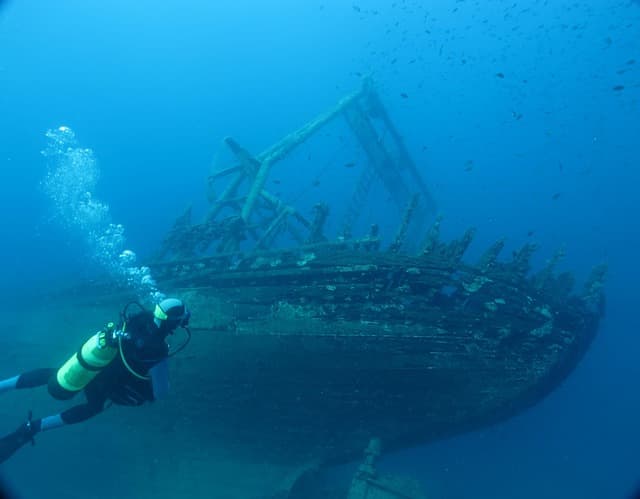 Image by Martin Str
The wreck is upright. Deck depths run about 15–25 metres along the hull. The sand is about 36 metres. That is a classic Mediterranean wreck sandwich: Open Water can taste the top if carefully briefed; Advanced Open Water can do the ship; Deep training is useful if you like time on the sand and the propeller.
A standard profile is a descent to the deck, a tour toward bow or stern, a drop to look at the screw from outside, and an ascent along the superstructure with a safety stop in the shallows of the wreck or in open water off the hull. Do not plan to “see everything” in one dive. One hundred and fifteen metres of tanker is a long swim at 20 metres.
Malta water is comfortable by northern European standards: high teens in winter, mid-20s in summer. A 5 mm suit is common in the warm months; add a layer in spring. Visibility is often 15–25 metres, sometimes better, sometimes a green soup after wind. The Faroud is exposed enough that vis and surge both matter.
Nitrox is a good match for a two-dive day: more time on the deck, less staring at a computer in the twenties. Surface intervals can be on the boat or, on a shore day, on the rocks with a dry bag and some humility about the climb.
If 36 metres still feels abstract, how deep you can scuba dive maps the 18 / 30 / 40 metre cards onto real wrecks like this one.
Accessibility: Shore, Boat, Season, and Permits
Wied iż-Żurrieq is the access village. In calm weather you can shore-dive: kit up, enter through the small harbour gap, and swim to the wreck. That swim is not a pool. Current, boats, and a long surface return if you miss the wreck are all real. Shore is a reward for good days, not a default.
When the sea is up, go by boat. Local centres run the Faroud as a standard trip. There is no shame in the boat. There is plenty of shame in a shore exit in surge with a tank on your back.
Malta dives year-round. Summer is the easy season for visiting divers. Winter is diveable but wind closes the south coast more often. If the Faroud is the reason you flew, keep a spare day and have a north-coast backup such as Cirkewwa.
You do not need a personal wreck permit as a guest of a licensed centre. You do need to follow Maltese heritage rules: no taking, no damaging, no unplanned penetration. The operator’s brief is the law you will actually hear. Listen to it.
Parking, steps, and summer crowds at Wied iż-Żurrieq are the unglamorous part of a shore day. Arrive early. Do not block the slip. The fishing harbour is still a working place.
Skills and License Required
PADI Open Water (18 m): Possible on the upper superstructure with a guide who will turn the dive before you drift down the hull. You will not see the sand at 36 metres legally or wisely. If this is your first wreck, keep it as a supervised exterior. The Open Water Diver certification guide is the 18-metre rule in writing.
PADI Advanced Open Water (30 m): The right level for a proper Faroud dive. You can run the deck, look over the side, and drop toward the lower hull without immediately breaking the Advanced limit. The sand at 36 metres is a Deep profile if you spend the dive there; dipping toward it on a planned tour is a conversation with your guide and your computer, not a dare.
PADI Deep Diver (40 m): Useful extra margin for propeller-level time and for two deep wrecks in a Maltese week.
Wreck specialty: Required for the engine room and for any real interior. The Faroud has spaces that look like corridors and are still overhead environments. No specialty, no engine room. That is not a house rule invented for this article; it is wreck diving practice everywhere. Get the wreck diving certification before you follow a GoPro into a dark doorway.
Buoyancy on an upright wreck should be boring. You hover beside the rail. You do not stand on the deck. Standing on wrecks is how handrails disappear and how memorials get wrecked a second time.
What You Will See
You will see a tanker that still looks like a tanker: bow, stern, deck plumbing, superstructure, and a propeller that photographs well from the sand. In good vis the silhouette appears before you arrive, which is a rare pleasure in wreck diving.
Marine life is Maltese rather than Red Sea: bream, grouper, the odd barracuda, damselfish, and a healthy coating of sponges and algae. Nudibranchs and smaller critters show up if you slow down. The wreck is the habitat. Dive it as a reef that happens to be 115 metres of steel.
The memorial context is part of what you “see” even if there is no plaque in your torch beam. Nine workers died. Behave like you know that.
Photographers: wide angle on the stern and propeller; a torch for the shaded side of the hull. Do not silt the engine-room door for a shot you could have taken from outside.
If you have more days in Malta, pair the Faroud with the shallow HMS Maori in Valletta and the P29 up at Cirkewwa — see our full Malta wreck diving guide for a 5-day island itinerary.
How to Dive It: Currents, Lines, and Penetration Rules
Current can run along this coast. On a shore dive, abort if the surface swim is a fight before you have even found the wreck. On a boat dive, use the shot or the guide’s descent. Do not guess the 115-metre hull is unmissable; in green water it is missable.
Navigate by obvious features: superstructure, then bow or stern as agreed. A tanker is a long rectangle. It is still possible to swim the wrong way for ten minutes. Turn around with gas, not with pride.
Penetration: engine room and internal spaces are wreck-specialty dives with a reel, lights, and a brief. Exterior swim-alongs along the deck are not penetration. Ducking through a hole because “everyone does it” is how overhead incidents start. If you have not been trained, you do not go in.
Watch boat traffic if you shore-dive. Wied iż-Żurrieq is busy in summer. A delayed surface marker buoy on ascent is good manners and good sense. Review scuba diving safety for SMB, gas, and abort habits that apply as much here as on a holiday reef.
No-touch is the whole conservation brief. The Faroud has been dived hard for decades. She does not need your extra wear.
Practical Logistics
Stay in the south if the Faroud is the priority, or accept a drive from the north. Malta is small; the traffic is not always small. Wied iż-Żurrieq has limited parking. Boat days remove the shore-entry circus.
Ask the centre how they run mixed groups. Open Water and Advanced divers should not be promised the same tour. Ask whether engine-room dives are only for wreck-trained guests. A centre that says “anyone can pop in” is telling you something useful; book somewhere else.
Bring a torch, DSMB, and enough thermal protection for two dives. Cylinders and weights are easy to hire. If you shore-dive, practise entries with rental gear at a easier site first. The Faroud swim is not the place to meet a new BCD.
Eat, shade, and water between dives. Maltese summer on black rocks cooks people who only planned the underwater half of the day.
English is widely spoken. You can do this wreck as part of a wider Maltese holiday that also includes reefs and caves. If wrecks are the point, give the Faroud two dives: one overview, one slower.
Final Thoughts
The Um El Faroud is a complete wreck dive: upright, big, memorial, and flexible between shore and boat. Advanced Open Water is the card that makes her honest. Wreck training is the card that makes the engine room honest.
Dive her for the nine men as well as for the propeller shot. Leave her as you found her. Then, if the week allows, go and see how different a destroyer bow and a patrol boat feel in the same small sea.
Frequently Asked Questions
- Can I shore-dive the Um El Faroud?
- Yes, in calm weather from Wied iż-Żurrieq. The swim and the exit are the limiting factors, not the wreck’s depth on paper. When the sea is up, go by boat. Do not invent a shore dive on a swell day because you skipped the boat fee.
- What certification do I need?
- Advanced Open Water is the honest level for a proper dive to the sand at about 36 metres. Open Water divers can work the upper superstructure if a guide keeps them inside 18 metres, but that is a truncated tour of a 115-metre tanker. Engine-room penetration needs a wreck specialty.
- Why was the tanker scuttled?
- In February 1995 an explosion during repairs in Valletta killed nine dockyard workers. The damaged Libyan tanker was later cleaned and scuttled in 1998 off Wied iż-Żurrieq as an artificial reef and as a memorial. Dive her with that story in mind.
- How deep is the Um El Faroud?
- She sits upright. The deck is roughly 15–25 metres depending where you are on the hull. The sand is about 36 metres. That spread lets Advanced divers see a complete ship without immediately going into decompression.
- Is the engine room open to all divers?
- No. The engine room is for wreck-trained divers on a planned penetration. Exterior decks, rails, and the propeller area (from outside) are the recreational tour. Light through a doorway is not a qualification.
Related articles
- Malta Wreck Diving: Best Shipwrecks in Malta & Gozo by Depth
Explore the best Malta wreck diving sites across Malta, Gozo, and Comino: from 14m Open Water shore wrecks like HMS Maori to P29, Um El Faroud, and Karwela.
- Best Wreck Diving in Europe: Ranked Sites and Depths
Best wreck diving in Europe ranked by popularity: Zenobia, Scapa Flow, Um El Faroud, Baron Gautsch, and more — with depth, licence, and Mediterranean notes.
- P29 Wreck Malta: Cirkewwa Shore & Boat Dive Guide (12–34m)
Diving the P29 wreck in Malta at Cirkewwa: depths (12–34m), shore vs boat entry, Rozi tug comparison, Open Water vs Advanced profiles, and penetration rules.
- HMS Maori Wreck Malta: Shallow WWII Destroyer Shore Dive
Dive HMS Maori off Valletta, Malta: a Tribal-class bow in 14-16 m. Shore or boat, Open Water friendly, protected WWII heritage. Look, and do not touch.
- Wreck Diving: Complete Wreck Diver Guide, Training & Best Sites
What is wreck diving and how do you become a wreck diver? Learn exterior vs penetration rules, PADI/SSI courses, essential wreck gear, and where to start.
- Wreck Diving Course & Certification: PADI vs SSI Wreck Diver Guide
Comparing a PADI or SSI wreck diving course? Learn prerequisites, 4-dive vs 2-dive wreck diver certification paths, costs, gear, and light-zone penetration rules.