Abu Nuhas Wrecks: Giannis D, Carnatic & Chrisoula K
Abu Nuhas wrecks north of Hurghada: Giannis D, Carnatic, Chrisoula K, and Kimon M — depths, Open Water vs AOW, and how day boats actually run the reef.
Abu Nuhas Wrecks: Giannis D, Carnatic & Chrisoula K
Sha’ab Abu Nuhas is a reef, not a single wreck. It sits north of Hurghada in the Strait of Gubal, right on a shipping lane, and it has wrecked enough ships that divers treat the reef as a small graveyard: Giannis D, Carnatic, Chrisoula K, and Kimon M.
This guide covers those four wrecks — depths, history, and who can dive which bits — plus how day boats from Hurghada actually run the site. For the wider Hurghada picture see diving in Hurghada and our best Hurghada dive sites. For wreck skills in general, start with wreck diving.
Where Sha’ab Abu Nuhas Sits
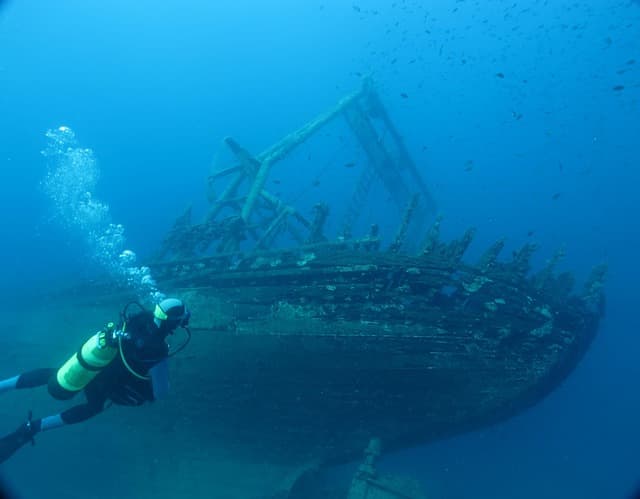 Image by Martin Str
Abu Nuhas (often written Sha’ab Abu Nuhas) is a large, barely awash reef at the southern end of the Strait of Gubal. Northbound and southbound traffic between the Red Sea and Suez has been clipping this corner for more than a century. The English name divers use, “father of copper” or similar folk etymologies, matters less than the geography: a shallow reef in a busy lane, with wrecks piled on the north side.
The four named wrecks lie close enough that a day boat can, in good weather, offer two of them in a day. Liveaboards on northern itineraries often spend a morning here on the way to or from Ras Mohammed and the SS Thistlegorm. Thistlegorm is a different dive — deeper, a war grave, wartime cargo — but it shares the same stretch of water and the same early starts.
Conditions are classic northern Red Sea: generally good visibility, seasonal wind (the Ghibli / northwesterlies can cancel Gubal trips), and current that is usually manageable compared with Tiran. Surface chop on the reef can still make exits messy. Mooring is on the wrecks or the reef; listen to the briefing for how you leave the shot.
This is not a shore dive. Everything is a boat from Hurghada, El Gouna, or a liveaboard. Trip length from Hurghada marina is typically a long morning — plan a full day, not a 9 a.m. two-tank local reef.
Giannis D: The Photogenic Stern
Giannis D is the wreck on most Abu Nuhas postcards. She was a Greek cargo ship (built 1969, formerly Shoyo Maru / Markos) carrying timber when she struck the reef on 19 April 1983. She sat on the reef for a time, then broke and slid. The stern section is the dive: intact, listing at about 45 degrees, with the propeller, helm, and a very photogenic engine room.
Depth. Superstructure and the high side of the stern are often quoted from about 4 metres down. The sand and the deeper parts of the stern sit around 24–27 metres. You can therefore have an Open Water-friendly circuit of the outside of the upper wreck, and an Advanced circuit that includes the sand and a longer look at the engine spaces.
The engine room. This is the bit people remember: skylights, catwalks, machinery, ambient light from above if you stay in the open. It is also an overhead environment. If you do not hold a wreck specialty, do not follow a group down the ladders into darker corners. Wide, lit openings with a clear exit are a briefing question, not a default yes.
The midships is more broken. The bow section lies separately on the reef. Guides usually concentrate on the stern because that is the complete picture. Wood cargo is long gone; fish and glassfish have moved in.
Giannis D is the wreck to request if you get only one Abu Nuhas dive and you like structure. It is also the wreck that tempts untrained penetration. Decide your limit on the boat, not at the skylight.
Carnatic: Wine, Gold, and Iron Ribs
Carnatic is the oldest of the four and, for many photographers, the most beautiful. She was a British P&O sail-and-steam passenger and cargo ship, wrecked on 13 September 1869 on her way from Suez toward Bombay. Around 30 people died. She was carrying mail, wine, and a well-known consignment of specie (gold and silver). Salvage in the years after the sinking recovered much of the treasure; you will not find a coin in the sand, and looking for one is not the point of the dive.
Depth. The wreck sits deeper than Giannis D’s playground: typically about 20–27 metres. That is Advanced Open Water for a comfortable tour. Open Water divers at 18 metres may see the upper ribs on a well-run profile, but the interesting length of the hull is below that.
What remains is an iron skeleton. Wooden decks have gone, so you look through coral-encrusted ribs rather than walking a promenade. Soft corals and glassfish fill the frames. The shape is still clearly a 19th-century steamer if you swim the length: bow, boilers, stern. Bottles from the wine cargo are part of the folklore. They belong on the wreck. Removing artefacts from Egyptian wrecks is illegal and wrecks the site for everyone after you.
Carnatic is a good second dive of the day after a deeper first wreck, or a first dive if the wind allows a longer bottom time at 20-odd metres. Nitrox helps if you are certified. Penetration in the Victorian sense barely applies — there is no intact hotel to enter — but you can still trap yourself in rib spaces. Stay in the open frames.
Chrisoula K: The Tile Wreck
Chrisoula K (often called the tile wreck) was a Greek freighter that struck Abu Nuhas on 31 August 1981 with a cargo of Italian floor tiles. Tiles are still stacked and scattered in the holds and on the sand. They are the easiest way to identify her if the briefing was vague.
Depth. The bow is jammed on the reef in roughly 5 metres. The wreck slopes down; the stern and propeller sit around 22–25 metres. That profile is unusually friendly: Open Water divers can spend a whole dive on the shallow bow and cargo, while Advanced divers can run bow-to-stern and finish on the reef.
She is more intact than Kimon M and less theatrical than Giannis D’s tilted stern. Swim-throughs exist in the cargo spaces. Treat them as overhead unless they are clearly open to the sky. Tiles have sharp edges; gloves help, but do not use the wreck as a ladder.
Chrisoula K is a common training wreck for wreck specialties out of Hurghada because the depth range lets an instructor keep Open Water students shallow and still show Advanced students the stern. If you are on a mixed boat, you may be split into two groups. That is a feature, not a snub.
Kimon M: The Lentil Wreck
Kimon M ran aground on 12 December 1978 with a cargo of lentils — hence lentil wreck. The lentils fed the fish decades ago. The ship itself is more broken than Giannis D or Chrisoula K, and she sits a little deeper.
Depth. Useful diving is often quoted from about 10 metres on the upper wreck to around 30–32 metres on the sand. The interesting structure — holds, engine parts, stern — tends to live in the Advanced band. Open Water divers can still do an exterior of the shallower wreckage if the guide sets a conservative profile, but this is usually the wreck centres save for AOW groups.
Current can be more noticeable here than on Giannis D. The wreck is less of a single photogenic silhouette and more of a debris field with large pieces. Some divers prefer her for that reason: fewer queues at the engine-room skylight, more swimming the outline.
If the boat offers Kimon M as dive two after Giannis D, watch your no-stop time and depth. Both wrecks can reach the 20s of metres. Nitrox and a computer you know how to read matter more than getting “all four wrecks” in two days.
Depth, Certification, and Who Can Dive Here
Open Water (18 m). Realistic, satisfying dives: Chrisoula K bow and midships; Giannis D exterior of the high stern and superstructure; a look at Carnatic’s upper ribs only with a strict profile; Kimon M only if the guide keeps you shallow. You should leave engine rooms and deep sterns for later.
Advanced Open Water (30 m). This is the typical licence for Abu Nuhas as a wreck destination. You can do proper circuits of all four, including Carnatic’s full length and Kimon M’s deeper structure, without scraping the recreational ceiling.
Deep specialty (40 m). Not required for these four. Nothing here asks for 40 metres. Save Deep for Thistlegorm’s sand if you want extra margin, or for other trips.
Wreck specialty. Required for any real interior: Giannis D engine room beyond a lit opening, cargo-hold duck-unders that lose the surface, anything where you cannot swim straight up. A day-boat “everyone goes in” is not a standard.
Abu Nuhas is a strong place to take a wreck specialty: four wrecks, clear water, and a depth spread that matches the course. It is a poor place to skip the course and copy the photographer in the engine room.
How to Get There from Hurghada
Day boats leave Hurghada (and sometimes El Gouna) for Abu Nuhas when wind and bookings allow. It is a north itinerary, longer than Giftun or Abu Ramada. Expect an early start, a longer steam, two dives, and a late return. Centres do not run this every day; ask the weekly schedule rather than assuming it is on the menu like a house reef.
Liveaboards that do “north wrecks” or “Gubal / Thistlegorm” weeks usually include Abu Nuhas because it sits on the way. That is often the more relaxed way to dive all four without racing the sun back to the marina.
You cannot book “the Giannis D shop.” You book a boat that is scheduled for Abu Nuhas and then see which wrecks the skipper chooses for wind and the group’s certification mix. State your licence and whether you want to stay outside. Mixed boats will split. That is normal.
For choosing a centre and the rest of the local sites, use the Hurghada overview linked above rather than chasing a single wreck name in a Facebook ad. These four ships also sit on the best wreck diving in the world shortlist, which is useful if you are comparing Abu Nuhas with Thistlegorm, Zenobia, or Truk.
Conditions, Marine Life, and Practical Tips
Visibility is often 15–25 metres, sometimes better. Winter can be windier; summer is hotter on the boat and still diveable. The reef itself is a proper Red Sea reef: anthias, glassfish on the wrecks, morays, and the usual lagoon fish. You came for rust and ribs, but the coral on Carnatic is the reason it photographs like a garden.
Currents are usually milder than Ras Mohammed’s sharky points, but Gubal is still open water. Hold the line down and up. Do not free-descend onto a wreck you cannot see if the skipper said there is current.
Conservation is simple and non-negotiable: no tiles in the luggage, no bottles from Carnatic, no “just a brass fitting.” Egyptian law and basic wreck ethics agree. Giannis D and the others are dive sites because the wrecks stayed in place.
Bring a torch even for exterior dives. The 45-degree stern of Giannis D throws shade. A cutter is sensible wherever fishing net exists — and it does.
If you have only two dives, Giannis D plus Carnatic (or Chrisoula K if the group is Open Water-heavy) is the usual pairing. Kimon M is the one to add on a liveaboard when you already know the other three.
Final Thoughts
The Abu Nuhas wrecks are why Hurghada is a wreck destination, not only a reef town. Four ships on one reef, from a Victorian steamer to 1980s cargo, in water clear enough to see the list of Giannis D from the shotline.
Match the wreck to the card: Open Water on Chrisoula K’s bow and Giannis D’s upper stern; Advanced for Carnatic, Kimon M, and the sand. Stay out of the engine room without wreck training. Leave the tiles and the wine bottles where they are.
When the boat is scheduled north, take it. Pair it with Thistlegorm on a liveaboard if you want the full Gubal wreck week — and treat that as two different dives, not one interchangeable “Red Sea wreck.”
Frequently Asked Questions
- How many wrecks are at Abu Nuhas?
- Divers usually visit four named wrecks: Giannis D, Carnatic, Chrisoula K (the tile wreck), and Kimon M (the lentil wreck). They sit on the north side of Sha’ab Abu Nuhas reef in the Strait of Gubal, north of Hurghada.
- Can Open Water divers dive Abu Nuhas?
- Yes, on the shallow parts. Chrisoula K’s bow is around 5 m, and Giannis D’s high stern starts very shallow. Carnatic and Kimon M are more Advanced. Stay outside interiors unless you hold a wreck specialty.
- How deep is Giannis D?
- The photogenic stern lists at about 45 degrees, from roughly 4 m on the high superstructure to about 24–27 m on the sand. The engine room is the famous interior; treat it as overhead and do not enter without wreck training.
- Is Carnatic an Advanced dive?
- Typically yes. The wreck sits around 20–27 m, so a full tour fits Advanced Open Water better than Open Water’s 18 m limit. Upper ribs may be visible on a strict Open Water profile, but the length of the hull is deeper.
- How do I get to Abu Nuhas from Hurghada?
- By day boat on a north itinerary, or on a liveaboard that includes the Strait of Gubal and Thistlegorm. It is not a shore dive and not a short local two-tank. Ask the centre’s weekly schedule; boats do not run it every day.
- Can I take a tile or wine bottle as a souvenir?
- No. Removing artefacts from Egyptian wrecks is illegal, and it wrecks the site. Photograph Chrisoula K’s tiles and Carnatic’s bottles; leave them on the wreck.
Related articles
- Wreck Diving: Complete Wreck Diver Guide, Training & Best Sites
What is wreck diving and how do you become a wreck diver? Learn exterior vs penetration rules, PADI/SSI courses, essential wreck gear, and where to start.
- 7 Best Hurghada Dive Sites You Must Experience
Discover the 7 best dive sites in Hurghada, Egypt. From the spectacular Abu Nuhas wrecks to the stunning coral gardens of Giftun Island and Abu Ramada.
- Diving the SS Thistlegorm: The Red Sea's Most Famous Wreck
Descend into history. Discover why the SS Thistlegorm is considered the best wreck dive in the world, with its cargo of WWII motorcycles and trucks.
- Diving in Hurghada: The Ultimate Guide to Egypt's Red Sea (2026)
Essential guide to diving in Hurghada. Discover the best dive sites, top resorts, prices, marine life, and everything you need for the perfect Red Sea trip.
- Best Wreck Diving in the World: Famous Sites Guide
Best wreck diving in the world: Thistlegorm, Zenobia, Truk, Coron, Spiegel Grove, Liberty, Coolidge, and Um El Faroud — with depths and certification notes.