MS Zenobia Wreck Diving in Cyprus: Depths and Guide
Dive the MS Zenobia off Larnaca: a 172 m ferry on her port side, trucks still chained, from 16 m to 42 m. Boat dive for Open Water to wreck-trained divers.
MS Zenobia Wreck Diving in Cyprus: Depths and Guide
The MS Zenobia is the wreck many Mediterranean divers plan a whole trip around. She is a Swedish Challenger-class RO-RO ferry, 172 metres long, lying on her port side a short boat ride from Larnaca. The high starboard side sits around 16 metres. The seabed under the hull is about 42 metres. Between those numbers you get a ship that still looks like a ship: rails, trucks, funnel, and a scale that photographs never quite capture.
She is often ranked among the world’s top ten wreck dives, and that ranking is not marketing fluff. Few ferry wrecks of this size sit in warm, clear water within a half-day trip of an international airport. If you are building a European wreck list, start with our guide to the best wreck diving in Europe and put Cyprus near the top.
This article covers the story of the wreck, the dive profile, how you reach her, what certification you actually need, what you will see, how to dive her without turning a holiday into an incident, and the practical logistics of a Larnaca-based trip.
The Story of the Wreck
The Zenobia was built in Sweden and launched in 1979 as a modern Challenger-class roll-on/roll-off ferry. She was designed to carry trucks and trailers on long sea routes. In June 1980 she was on her maiden commercial voyage, bound for the eastern Mediterranean with a full load.
On 7 June 1980, off Larnaca, she developed a serious list. Water and ballast problems turned a manageable heel into a capsize. The people on board were taken off. There were no casualties. The ferry rolled onto her port side and went down with around £200 million of cargo still aboard.
That cargo is why the dive is famous. One hundred and four trucks remain chained on the decks. Some still hold the outlines of their loads. The wreck is a time capsule of early-1980s freight, not a warship and not a grave of crew. Treat it as industrial heritage all the same: nothing comes home in a pocket.
Salvage talk came and went. The ship was too large, too deep at the keel, and too expensive to raise intact. She stayed where she fell, a few kilometres off Larnaca, and the Cyprus dive industry grew up around her. Decades of diving have worn some fittings and opened some plates, but the silhouette is still unmistakably a ferry on her side.
Because she is not a war grave, the ethical rules are simpler than on a battleship. The conservation rules are not. Cyprus protects underwater cultural heritage. Do not lift artefacts. Do not cut souvenirs. Photograph the trucks; leave the rust.
Depth and Dive Profile
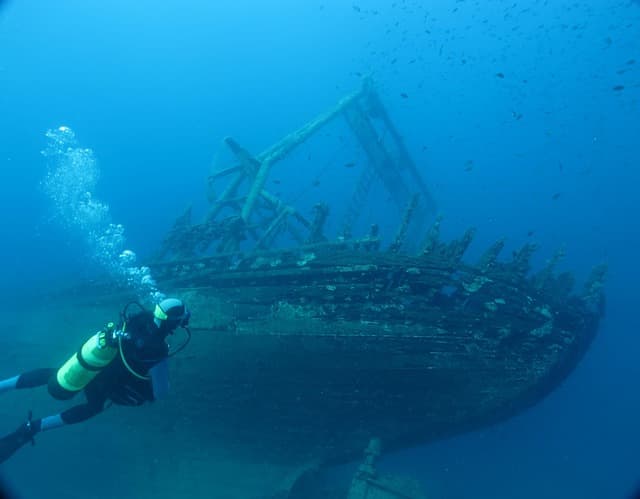 Image by Martin Str
The Zenobia lies on her port side. That orientation is the whole profile. The starboard side is the “roof” of the dive: rails and superstructure in the 16–18 metre band. Mid-hull features sit in the mid-twenties. The deepest sand, under the port side, is about 42 metres.
A typical first dive is an exterior tour of the high side. You descend the shot or the stern/bow reference your guide prefers, swim the starboard rail, look into truck decks from outside, and work back along the hull. Bottom time is comfortable if you stay high. Air lasts longer at 16 metres than it does at 35.
A second dive, for Advanced Open Water divers, usually drops a little deeper: propeller area, lower hull, or a longer run along the length. At 30 metres you are at the PADI Advanced limit. The sand at 42 metres is a Deep Diver or equivalent profile, and it is easy to overstay if you chase the keel without a plan.
Water in Larnaca Bay is Mediterranean: roughly 16–18°C in winter and the mid-to-high 20s in late summer. A 5 mm full suit is enough for many summer divers; a semi-dry or 7 mm is kinder in spring and autumn. Visibility is often 15–25 metres, sometimes more on a still day. That visibility is why the wreck photographs so well: you can see enough of the 172-metre hull to feel the size.
Plan two dives if you can. One overview, one focused. Nitrox is common and useful because the wreck invites time, not a single deep bounce. Surface intervals happen on the boat. There is no need to push a third dive on the same day unless you are on a dedicated wreck week and your gas and computers agree.
If you want a clear reminder of why 18, 30, and 40 metres are not the same dive, read how deep you can scuba dive before you book the deeper profile.
Accessibility: Boat, Season, and Permits
The Zenobia is a boat dive from Larnaca. Boats leave from the marina area and reach the site in a short run in normal weather. There is no shore entry that makes sense. Swimming from the beach would be a long, exposed, and unnecessary exercise.
Cyprus dives year-round. Peak season for visiting divers is roughly April to November, when the sea is calmer and the water warmer. Winter is diveable but wind and swell cancel more days. Build a spare morning into a short trip. Larnaca is a working harbour; operators know the local forecast better than a hotel whiteboard.
You do not need a special wreck permit as a recreational diver joining a licensed centre. You do need to dive with an operator who is allowed to use the site and who will brief you on local rules. Cyprus treats the wreck as a dive attraction and as heritage. Follow the centre’s brief on where you may go and what you may not touch.
Weather windows are usually generous compared with the Atlantic. That does not mean every day runs. If the boat is cancelled, Larnaca still has shallower sites. Do not shop around for someone willing to launch in a poor sea state just to tick the Zenobia box.
Skills and License Required
Match the part of the wreck to the card in your logbook.
PADI Open Water (18 m): You can do a guided exterior dive on the high starboard side. Stay with the guide. Do not drop down the hull “just to look.” Eighteen metres is the limit, not a suggestion. If you are newly certified, this is still a big, busy site. Buoyancy and awareness matter more than the number of dives on your card. Our Open Water Diver certification guide explains that 18-metre ceiling in context.
PADI Advanced Open Water (30 m): This is the realistic level for a “proper” Zenobia dive: more of the hull, the trucks seen from better angles, and a longer run without watching the computer hit the Open Water stop. Complete the deep adventure dive and be honest about your last 25-metre dives. The Advanced Open Water guide is the right next step if you only have Open Water.
PADI Deep Diver (40 m): Needed if your plan includes the seabed under the wreck or a long time in the high thirties. Forty-two metres is beyond the standard Advanced limit. Do not treat “the sand is right there” as a reason to exceed training.
Wreck specialty: Required before any penetration of car decks, alleyways, or the engine room. An overhead environment is an overhead environment even when the exits look obvious on a ferry. Silt, lines, and trapped fishing gear are all present. A wreck course, a reel, and a guide who dives the interior regularly are the minimum. Exterior swimming along the hull is not penetration. Going in is.
Bring a torch even for the outside. Bring a delayed surface marker buoy and know how to send it. Cyprus boats run a tight ship, but you still need to be found if you surface off the wreck.
What You Will See
The first impression is size. One hundred and seventy-two metres of ferry on her side fills the vis. The funnel, rails, and vehicle decks give you landmarks so you do not get lost in a steel maze.
The trucks are the signature. They are still chained. Some sit in rows that still look like a working deck. You will photograph one, then realise there is another row behind it. Look, do not climb, and do not pull at straps or plates.
Outside the hull you get Mediterranean fish rather than a coral circus: bream, grouper, barracuda on a good day, and the usual damselfish and wrasse. Growth on the steel is sponges, algae, and filter feeders, not Red Sea soft coral. The atmosphere is industrial and blue, not tropical.
Photographers should think wide. A mid-range zoom will crop the wreck into anonymous rust. Ambient light on the high side is often enough in summer; a torch brings colour back on the deeper plates. Watch your fins over the trucks. Silt here is not cave silt, but you can still wreck a buddy’s photo and your own vis.
If you have wreck training and a planned interior, the engine room and deeper vehicle spaces are the “magazine cover” dives. If you do not, the exterior is still a world-class dive. Do not invent a swim-through because someone on the boat said it was easy.
How to Dive It: Currents, Lines, and Penetration Rules
Current on the Zenobia is usually mild compared with a channel wreck, but it is not always zero. Listen to the brief. Descend on the agreed line or with the group. Do not free-descend into blue water and hope the 172-metre hull is “hard to miss.” It is missable if you drop off the shot in a current.
Stay with your buddy. The wreck has many similar windows and rails. It is easy to follow a different truck row and lose the pair. Agree a lost-buddy procedure before you splash: search briefly, then up the line or send a blob.
Penetration is a trained activity, not a holiday upgrade. No wreck specialty means no interior. That includes “just the first garage” and “we could see light.” Light does not make it an open-water dive. Fishing line, collapsed plating, and silted corners are all documented on this wreck. If you want interior skills, take a wreck diving certification course, ideally with dives on a wreck your instructor knows.
Do not tie into weak fittings. Do not pull on the remaining cargo. Gas planning should assume you might work harder than on a reef: you will swim more, take pictures, and stop often. Turn the dive with gas, not with “one more truck.”
For general habits that keep wreck dives boring in the right way, see scuba diving safety.
Practical Logistics
Fly into Larnaca. The wreck is the local headline site, so you will not struggle to find a centre that runs Zenobia days. Ask how they run the dive: group size, whether Open Water divers stay on the high side, and whether wreck-trained divers get a separate interior brief. Those questions matter more than a glossy “best in Cyprus” claim.
A dedicated Zenobia day is usually two dives with a surface interval on the boat. Bring surface shade, water, and a warm layer for the ride back. Nitrox is worth requesting in advance if you want longer second dives.
Gear: a torch, a DSMB, a cutting tool you can reach, and enough thermal protection for the actual water, not the Instagram water. If you plan interior dives, bring the wreck kit your training specified: reel, backup light, and the discipline to use them.
Cyprus is easy logistics: English is widely spoken in dive centres, the euro is the currency, and Larnaca has hotels in every budget. You can dive the Zenobia as a long weekend from many European cities. You can also pair her with other Cyprus sites, but if you only have two days, give them to this wreck.
If Malta is also on your list, the Um El Faroud is a different flavour of large Mediterranean wreck: upright tanker, memorial, and a mix of shore and boat. For a wider map of wreck travel, use our wreck diving hub.
Final Thoughts
The MS Zenobia earns her reputation because the numbers and the story line up. A 172-metre ferry, no loss of life, a fortune in cargo, and a profile that Open Water divers can taste and Advanced divers can explore properly. Stay on the high side if that is your limit. Get wreck trained before you go inside. Leave the trucks where they are.
Book the boat, check the forecast, and give her two dives. One is a look. Two is a dive you will still be talking about on the flight home.
Frequently Asked Questions
- Can an Open Water diver dive the MS Zenobia?
- Yes, on the exterior of the high (starboard) side around 16–18 m, with a guide who keeps the dive inside Open Water limits. A proper tour of the hull, trucks, and deeper structure needs Advanced Open Water. Interior spaces such as car decks and the engine room need a wreck specialty and a planned penetration briefing.
- How deep is the Zenobia wreck?
- The ferry lies on her port side. The shallow starboard rail is about 16 m. The seabed under the wreck is about 42 m. Most recreational dives work the high side and mid-hull between those numbers rather than sitting on the sand for the whole dive.
- Is the Zenobia a shore dive?
- No. She sits off Larnaca and is reached by boat from Larnaca marina. There is no realistic shore swim. Operators run one or two dives on the wreck as a dedicated trip; liveaboards are not the usual format here.
- Did anyone die when the Zenobia sank?
- No. The Swedish RO-RO ferry capsized on her maiden voyage on 7 June 1980. The people on board were evacuated. The tragedy is economic and environmental rather than a loss of life: cargo worth around £200 million went down with her, including 104 trucks that remain chained on the car decks.
- Do I need a wreck specialty to enjoy the Zenobia?
- Not for an exterior dive. You can have an excellent dive swimming the hull, funnel, and high-side rails without entering. You do need wreck training, a reel, and a guide who treats the wreck as an overhead environment before you enter car decks or the engine room. Never treat a swim-through as a shortcut if you have not been trained for it.
Related articles
- Best Wreck Diving in Europe: Ranked Sites and Depths
Best wreck diving in Europe ranked by popularity: Zenobia, Scapa Flow, Um El Faroud, Baron Gautsch, and more — with depth, licence, and Mediterranean notes.
- Wreck Diving: Complete Wreck Diver Guide, Training & Best Sites
What is wreck diving and how do you become a wreck diver? Learn exterior vs penetration rules, PADI/SSI courses, essential wreck gear, and where to start.
- Wreck Diving Course & Certification: PADI vs SSI Wreck Diver Guide
Comparing a PADI or SSI wreck diving course? Learn prerequisites, 4-dive vs 2-dive wreck diver certification paths, costs, gear, and light-zone penetration rules.
- Um El Faroud Wreck Malta: History, Depths, How to Dive
Dive the Um El Faroud off Wied iż-Żurrieq, Malta: a 115 m tanker, upright 15–36 m, shore or boat. Advanced Open Water; wreck training for the engine room.
- Best Wreck Diving in the World: Famous Sites Guide
Best wreck diving in the world: Thistlegorm, Zenobia, Truk, Coron, Spiegel Grove, Liberty, Coolidge, and Um El Faroud — with depths and certification notes.