Baron Gautsch Wreck Croatia: The Adriatic Titanic Dive
Dive the Baron Gautsch off Rovinj, Croatia: an Austro-Hungarian liner mined in 1914, 28–40 m. A civilian grave. Advanced Open Water and quiet respect.
Baron Gautsch Wreck Croatia: The Adriatic Titanic Dive
The Baron Gautsch is the wreck Croatian divers mention when the talk turns serious. She was an Austro-Hungarian passenger liner. On 13 August 1914 she hit an Austro-Hungarian mine off Rovinj and went down. More than 100 people died; some accounts put the number much higher. It was a civilian tragedy in the first month of a world war. The press nickname “Adriatic Titanic” is lurid. The grave is real.
She lies in 28–40 metres of Adriatic blue, a profile that asks for Advanced Open Water and, in practice, a few dozen dives already in the logbook. This is not a first wreck after a resort course. It is a reason to visit Istria if you already dive, and a reason to wait if you do not.
If you are choosing among Europe’s wreck dives, put the Gautsch in the “respect first” column with Scapa, not in the theme-park column. This guide covers the story, the depths, access, skills, what remains to see, how to dive a grave, and how to run the trip from Rovinj.
The Story of the Wreck
The Baron Gautsch was built for passenger service under the Austro-Hungarian flag, a liner on Adriatic routes rather than a transatlantic giant. In August 1914 the empire was suddenly at war. Minefields went into the water to keep enemy ships out. They did not only keep enemies out.
On 13 August 1914, off the Istrian coast near Rovinj, the liner struck a mine laid by her own navy. The ship sank. Passengers and crew went into the water. Rescue was partial. Death tolls in print do not agree. You will see figures from around 150 to around 300. This article will not pretend to settle a historical argument. What is solid is this: more than 100 people died, many of them civilians, and the sinking was a disaster, not a battle honour.
She has been called the Adriatic Titanic because a passenger ship went down with heavy loss of life. The comparison is about public shock, not about sister hulls in Belfast. Use the nickname if you must. Dive the wreck as the Baron Gautsch, a named grave.
The site is protected as cultural and historical heritage. Croatia does not owe you a souvenir. Families of the dead do not owe you a swim-through. The correct posture is the same as on any civil or war grave: no touching, no taking, no moving bones of the ship for a better angle.
Depth and Dive Profile
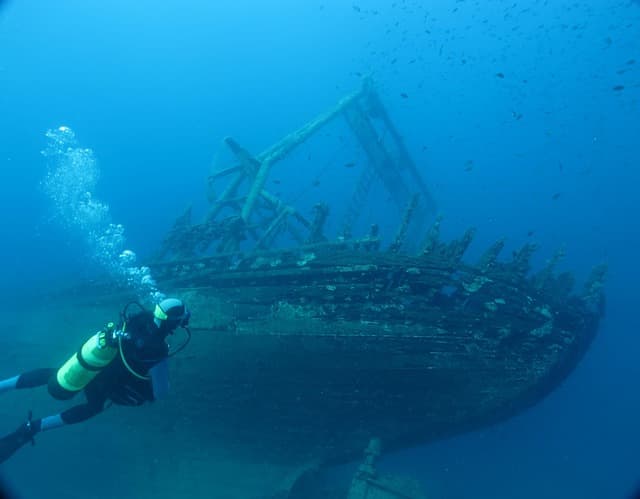 Image by Martin Str
The wreck sits in the 28–40 metre band. That is the whole conversation about certification. Twenty-eight metres is already beyond Open Water. Forty metres is the recreational Deep ceiling. A “quick look at the sand” is a Deep dive. A tour of the higher structure can be planned as an Advanced dive if you stay disciplined.
Typical profile: descend the shot, arrive on the wreck, complete a slow circuit or a bow-to-stern as briefed, and leave with gas to spare for the stop. Adriatic vis is often good enough to see a large piece of liner at once. That gift is also a trap. You stay longer because it is beautiful. Your computer does not care.
Water in the Croatian season is usually more comfortable than Scapa: high teens to the mid-20s depending on month. A 5 mm suit is common in summer; spring divers may want more. Visibility is frequently 15–25 metres when the sea is settled. After bora or a blow it can drop. The skipper, not your hotel, calls that.
Two dives on the Gautsch in one day is possible for well-trained divers on nitrox with a long interval. Many visitors do one Gautsch dive and a shallower second site. That is not cowardice. That is how you still have a brain at dinner.
Read how deep you can scuba dive if you need the 30-versus-40-metre distinction spelled out before you pay for the boat.
Accessibility: Boat, Season, and Permits
The Baron Gautsch is a boat dive from Rovinj, on the west coast of Istria. There is no shore option. The wreck is offshore. Boats are the whole sport.
Season for visiting divers is roughly May to October, with July and August the busiest. The Adriatic can be mill-pond or unpleasant. Build a spare day. Rovinj has other diving if the liner is blown out; it does not have a second Gautsch.
Dive with a centre that regularly runs this wreck, not with a generalist who “can find it on GPS.” Shot placement, current, and heritage briefings are local knowledge. You do not need a separate tourist permit in your pocket as a guest of a licensed operation, but you do need to follow Croatian rules on protected wrecks. The brief will include no-take and no-damage. Take it as binding.
Group size matters on a 28–40 metre grave. Ask how many divers share a guide. A circus on the shot line is how fins hit history.
Skills and License Required
PADI Open Water (18 m): Not this wreck. Eighteen metres does not get you there. Do not ask for an exception. Do another Croatian site and come back after Advanced.
PADI Advanced Open Water (30 m): The minimum card. In the real world, centres often look for around 40 logged dives as well. That is not snobbery. Task loading at 30 metres on a liner, in a group, is different from a 12-metre reef. The Advanced Open Water certification guide is the training path; logged deep dives are the practice.
PADI Deep Diver (40 m): Recommended if your plan includes the deeper parts of the 28–40 metre range. Forty metres is not a place to “see how it feels.”
Wreck specialty: Required for penetration. Strongly recommended even if you intend to stay outside, because the course also teaches how not to silt, snag, or get drawn into openings. Get wreck certified on a less loaded site if this would be your first overhead.
This is a grave. Skills include self-control. If you cannot hover without grabbing, you are not ready, whatever the card says.
What You Will See
You will see a passenger liner’s remains in Adriatic light: hull, openings, the geometry of a ship that was built to carry people, not ore. Growth is Mediterranean: sponges, scorpionfish, conger in holes, and fish using the wreck as an apartment block. It is prettier than a northern battleship and more solemn than a purpose-sunk reef.
Details depend on vis and on how much of the wreck your guide chooses to show. Do not expect a museum of luggage. Expect steel, habitat, and the knowledge of why she is here.
Photography should be wide and unhurried. Do not fan silt off a window. Do not pose on fittings. If someone in the group is shooting, give them water column, not a kick.
Croatia has other wrecks if you have the week. The Stuka Ju 87 is a different emotional register: an aircraft, not a liner. The Francesca da Rimini is another Istrian name on many lists. Neither replaces the Gautsch. They complement a trip that already treats wrecks as history.
How to Dive It: Currents, Lines, and Penetration Rules
Descend the shot as a pair. Current can appear even on a pretty day. If you miss the wreck, send a blob and get picked up. Hunting at 35 metres is how air and no-stop time vanish.
Move slowly. Keep the hull as a reference. Agree bow or stern as a turnaround. Lost-buddy: short search, then up. The boat should have your plan.
Penetration is not a default. No wreck specialty means no interior, including “just the first room.” Even with the specialty, many divers stay outside on this wreck because it is a civilian grave. That choice is the mature one, not the timid one. If you do enter, it is a planned, lined, briefed penetration, not a follow-the-leader.
No-touch is absolute. This is not a debate about “small bits of coal.” It is a grave. If you need a rule in writing, use the same rule as other wreck diving ethics: look, photograph, leave.
Gas: turn early. Deep plus cameras plus emotion is a known mix. Scuba diving safety is the dull checklist that keeps graves from collecting modern divers.
Practical Logistics
Rovinj is the base: pretty, busy in summer, and set up for diving. Stay near a centre that actually runs the Gautsch, or accept a transfer to the harbour they use. Ask about the week’s wreck forecast, not only about hotel parking.
Bring a torch, DSMB, and a computer you trust. Nitrox is worth it. If you have not dived to 30 metres recently, do a tune-up dive on something shallower the day before. The liner should not be your first deep dive of the year.
Do not hunt for a shop that advertises itself as the only serious operator in Istria. Ask about guide ratios, whether they require Advanced plus dive count, and how they brief the grave. Those answers rank centres better than adjectives.
Summer boats fill. Book the Gautsch day, then book a backup day. If you only have one morning, you may meet the bora instead of the wreck.
Between dives, Rovinj is a town, not a liveaboard corridor. Eat, hydrate, and stay out of the midday sun if you have a second dive. Croatian summer on a stone quay is part of the profile.
If you have never dived the northern Adriatic, do a shallower site the day before. The Gautsch should not be your first look at 28 metres, your first look at a liner, and your first look at Croatian boat procedures on the same morning. Split those firsts. The wreck will still be there on Tuesday.
Final Thoughts
The Baron Gautsch is a deep, beautiful, and heavy dive. More than 100 civilians died when an empire’s mine met an empire’s liner. Advanced Open Water and a quiet logbook are the entry price. Wreck training is the only path inside, and staying outside is still a complete dive.
Go to Rovinj when you are ready. Descend the shot. Leave the wreck as a grave. That is the whole sport on this site.
Frequently Asked Questions
- Why is the Baron Gautsch called the Adriatic Titanic?
- She was a passenger liner that sank with a large civilian death toll after hitting a mine in the first weeks of the First World War. The nickname is journalistic, not official. What is not in dispute is that this was a civilian tragedy and that the wreck is a grave.
- How many people died?
- Published figures vary, often between about 150 and 300. Treat “more than 100” as the honest floor and avoid repeating a precise number as if it were settled. The important fact for divers is that families lost civilians, including children, not only sailors.
- What certification do I need?
- Advanced Open Water, and in practice a solid 40 or more logged dives. The wreck sits at 28–40 metres. Open Water’s 18-metre limit does not reach her. Deep training helps if you want time in the high thirties.
- Can I go inside the wreck?
- Only if you hold a wreck specialty and the dive is planned as a penetration with a guide who knows this hull. Even then, remember it is a grave. Many divers choose to stay outside. That is not a lesser dive.
- Is it a boat dive?
- Yes. The Baron Gautsch lies off Rovinj in Istria. There is no shore dive. Boats run in the Croatian season, typically late spring through early autumn, when the Adriatic is in a working mood.
Related articles
- Best Wreck Diving in Europe: Ranked Sites and Depths
Best wreck diving in Europe ranked by popularity: Zenobia, Scapa Flow, Um El Faroud, Baron Gautsch, and more — with depth, licence, and Mediterranean notes.
- Stuka Ju 87 Wreck Diving: Croatia's Rare Dive Bomber
Dive a rare Junkers Ju 87 R-2 Stuka south of Žirje, Croatia: intact fuselage, wings and tail at 28m. Italian Air Force, AOW, licensed boat operators only.
- Francesca da Rimini Wreck Diving Near Kaprije, Croatia
Francesca da Rimini is a 42m Italian cargo torpedoed in 1944 near Kaprije. Deck at 38–52m, mast to 28m, mines still on site. AOW plus Deep; permit only.
- Wreck Diving: Complete Wreck Diver Guide, Training & Best Sites
What is wreck diving and how do you become a wreck diver? Learn exterior vs penetration rules, PADI/SSI courses, essential wreck gear, and where to start.